I would like to express my sincere gratitude
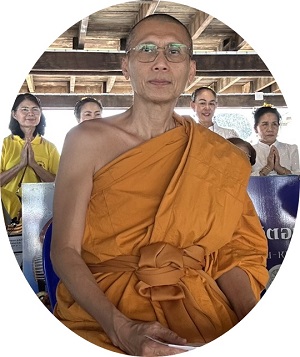
to Dr. Phra Athikarn Suchart Chantasaro,
the abbot of Wat Koh Welukaram,
for filming this video clip.
Please click on the red Play button similar to this image
in the middle of the screen to watch.
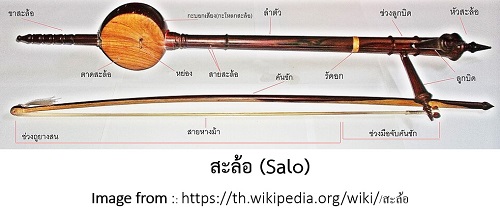
Salo
The salo (Northern Thai dialect: ) is a traditional Lanna stringed instrument. It comes in both two-string and three-stringed
versions and is often used as a lead instrument in ensembles with other instruments such as the salo, saw, and sueng.
Salo come in three sizes: small, medium, and large, each playing a different role in the ensemble. It is most often played
with the Lanna flute because it allows for the expression of emotions and the imitation of human voices. The salo is a delicate
instrument, as the type of surface it is played on significantly affects its sound.
The video below is a solo performance of the salo
(a type of Thai string instrument),
"Prasat Wai," by Mr. Woraprat Saengphrakarn.
Please click on the red Play button similar to this image
in the middle of the screen to watch.
Children can also play the salo (a type of Thai string instrument).
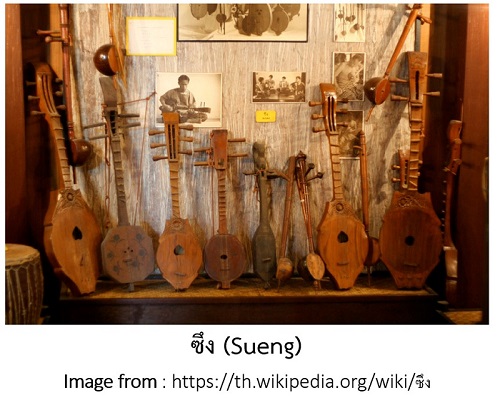
Sueng
The sueng is a plucked string instrument with four strings, but divided into two sets of two strings each. It resembles the
krachappi but is smaller. The total length of the neck and body is approximately 81 cm. The body is round, with a diameter of
about 21 cm. Both the body and neck are made from a single piece of hardwood, hollowed out in the center. A circular piece
of wood is cut and drilled with a hole in the center to create a resonant sound. The neck is flat and square at the front to
accommodate nine finger rests (taban or numb). The end of the neck is curved and grooved, with two tuning pegs on each side
(four in total) for the four strings. The sueng uses two thin wire strings and two thicker strings. It is a popular plucked instrument
among people in northern Thailand, often played alongside the pi so or pi jum and salo.
Based on size, there are three types: small sueng, medium sueng, and large sueng (sueng luang). There are also two types:
sueng with 3 strings and sueng with 4 strings (the difference lies in the sound; in the 3-string sueng, the sol note is at the bottom,
while in the 4-string sueng, the sol note is at the top).
Regarding the terms "salaw," "saw," and "sueng," which are often colloquially used as instruments of the Lanna people, in reality,
only the sueng and salo are considered Lanna instruments. The word "saw" here refers to "singing saw," which is a form of singing,
narration, and storytelling accompanied by a pi jum ensemble.
Note: If you want to watch other videos on the same page, please pause
()
the video you are currently watching and then watch the video you want.
If you would like to see and hear a solo performance on an instrument called
the "Seung". by Mr. Niam, a male musician from northern Thailand,
(Solo performance by Father Niam, a relaxing Lanna-style musician,
April 16, 2006, Muang Pan District, Lampang Province, Thailand.)
Please click on the red Play button similar to this image
in the middle of the screen to watch.
If you would like to see and hear a solo performance on a Thai string
instrument called the "Sueng," playing the song "Prasat Wai." (solo by Tengkolung.)
Please click on the red Play button similar to this image
in the middle of the screen to watch.
Children can also learn and practice playing the musical instrument
called "Seung". Please click on the red Play button similar to this image
in the middle of the screen to watch.
รีวิวซึงเพลงปราสาทไหว ครูทำซึงให้เด็กเล่น | ครูมณฑล ธงเทียน
Playing a musical instrument called "Seung" by children;
the teacher made seung for the children to play
Teacher Monthon Thongthian


 )
) ,
,
 )
on your web browser
)
on your web browser